

Europe’s flagship carbon capture and storage (CCS) initiative, Northern Lights JV, has formally started commissioning operations with the first volumes of liquefied CO2 (LCO2) loaded onboard the dedicated carrier, Northern Pioneer, sourced from its first customer, Heidelberg Materials.
The joint venture between Equinor, Shell, and TotalEnergies is central to Norway’s Longship programme and aims to decarbonise European heavy industry by providing cross-border CO2 shipping and permanent offshore storage. The LCO2 for this initial commissioning phase was sourced from Heidelberg Materials’ cement plant in Brevik, Norway.
Northern Lights obtained all the necessary regulatory approvals in May 2025, including permits from Norway’s Ministry of Energy, the Ministry of Climate and Environment, the Norwegian Environmental Agency, and the Norwegian Ocean Industry Authority. The Phase 1 licence permits the injection and sequestration of up to 37.5 million tonnes of CO2 over a 25-year period. Storage takes place approximately 2,600 metres beneath the North Sea seabed in saline aquifers.
Tim Heijn, Managing Director of Northern Lights JV, said of the approvals: ‘This is a major milestone for the carbon capture and storage chain in Norway. The Norwegian authorities have granted the permits required to inject and store CO2 on the Norwegian continental shelf. With these consents in place, we are on track to safely start CO2 transport and storage operations in Northern Lights.’
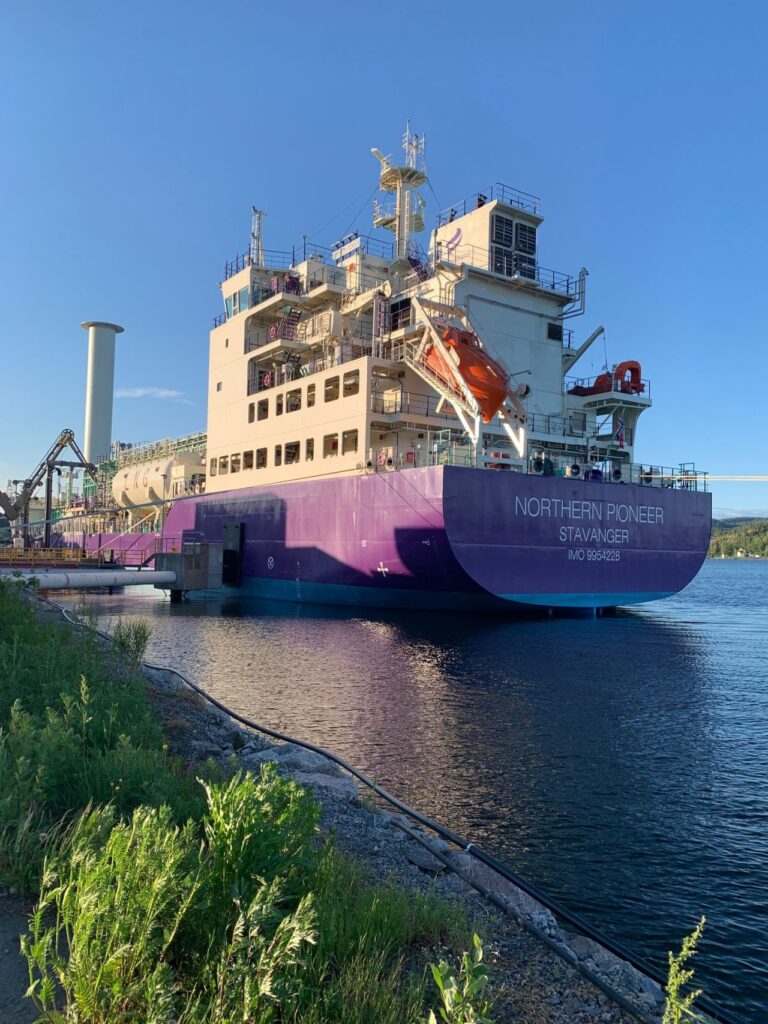
The Northern Pioneer, a 10,000-dwt LCO2 carrier built by Dalian Shipbuilding in China and delivered in late 2024, is the first of four ships designed to service the CCS network. The vessel can transport approximately 7,500 cubic metres of LCO2 under cryogenic conditions of -35°C and at pressures of up to 19 bar. It will be joined by the Northern Pathfinder, which has already been delivered, along with two additional vessels that are currently under construction in China, all of which will be operated by K Line LNG Shipping (UK).
The long-term goal is to expand Northern Lights’ capacity in response to commercial demand. A final investment decision was taken in March 2025 for Phase 2, which will increase annual CO2 transport and storage capacity from 1.5 million tonnes to a minimum of 5 million tonnes starting in 2028. This expansion is partly funded by the EU’s Connecting Europe Facility for Energy.
Commercial uptake is already underway. In addition to Heidelberg Materials, Stockholm Exergi has signed a contract for the annual shipment and storage of 900,000 tonnes of biogenic CO2. Yara was the first commercial customer, agreeing to transport 800,000 tonnes per year from its ammonia and fertiliser plant in the Netherlands to the Northern Lights site.
TotalEnergies has stated its aim to develop over 10 million tonnes of CCS capacity by 2030, with Northern Lights designated as a Project of Common Interest by the EU. ‘We’re proud to share that commissioning has started, with LCO2 from our first customer Heidelberg Materials in Brevik, now beginning gassing up our vessel Northern Pioneer,’ Northern Lights confirmed in a 3 June update on LinkedIn.