

The Fund for Energy Efficiency Technologies (FEET), founded by the Global Centre for Maritime Decarbonisation and managed by AIM Horizon Investments, tackles long standing barriers that have slowed the adoption of technologies such as wind assisted propulsion and air lubrication systems. The fund has secured total commitments of up to US$35 million.
The initiative is structured around a pay-as-you-save model that directly links lease repayments to verified fuel and regulatory savings. The approach reflects growing interest in mechanisms that reduce the financial difficulties associated with shipboard energy efficiency technologies. Although these solutions promise immediate fuel savings, uptake has been constrained by variable performance, inconsistent measurement methodologies and difficulties in predicting payback periods. The long-established split incentive problem has further discouraged investment.
FEET seeks to address these challenges through unsecured leases that decouple retrofit finance from vessel mortgages. Under the structure, the fund can provide up to 100 per cent of the upfront equipment, installation and sensorisation costs. Repayment is then tied to verified operational savings. This is supported by data collection and analytics undertaken through GCMD’s performance pilots, which use enhanced sensors and modelling to quantify efficiency gains with statistical confidence.
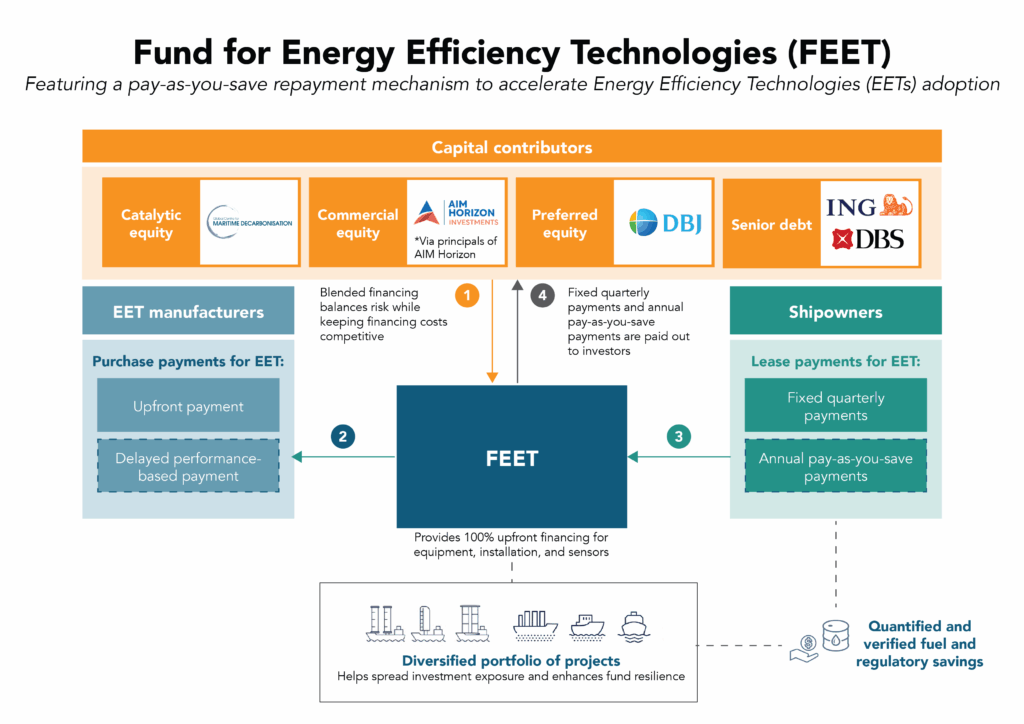
The fund’s blended capital structure includes catalytic equity from GCMD, commercial and preferred equity commitments, and senior debt from financial institutions including ING and DBS Bank. The Development Bank of Japan holds a preferred equity position. By diversifying across technologies, manufacturers, vessel types and owners, the fund aims to manage risk while keeping financing competitive. Several projects have already reached the final investment decision stage.
Industry partners have emphasised the strategic importance of energy efficiency in meeting tightening carbon regulations. DBS observed that shipping’s share of global greenhouse gas emissions, combined with its central role in global trade, creates both urgency and opportunity for scalable solutions. ING highlighted the usefulness of efficiency retrofits in accelerating the sector’s wider decarbonisation push.
The long-term plan is to scale FEET to US$500 million by 2030, a size that could support retrofits for approximately 200 vessels. As the project portfolio grows, the fund is expected to generate richer performance datasets, improve cost efficiency and strengthen the commercial case for further investment in energy saving technologies. The model is intended to create a reinforcing cycle in which data, scale and investor confidence support broader adoption across the global fleet.