

Mitsui O.S.K. Lines and Shell have launched a joint book and claim initiative using 123Carbon’s registry, which enables cargo owners to account for emissions reductions without directly using low-carbon fuel on their shipments.
The initiative uses environmental attribute certificates (EACs) that are generated by switching fuels on third-party vessels. Shell arranged for a vessel operator to replace very low sulphur fuel oil (VLSFO) with fatty acid methyl ester, a lower-carbon biofuel. The vessel operator retained the Scope 1 emissions benefit linked to its own operations, while waiving the Scope 3 component associated with cargo owners.
That Scope 3 reduction was recorded in 123Carbon’s digital registry and allocated to MOL. After verification under the Smart Freight Centre’s Market-Based Measures Accounting Framework, MOL converted the allocation into environmental attribute certificates. These are offered to customers through the company’s insetting programme and enable them to claim emissions reductions linked to maritime transport.
Carbon insetting allows the emissions benefit associated with a specific fuel-switch event to be separated from the physical movement of cargo. Cargo owners can purchase verified emissions reductions linked to biofuel use on vessels operating on different routes, which are supported by a documented chain of custody.
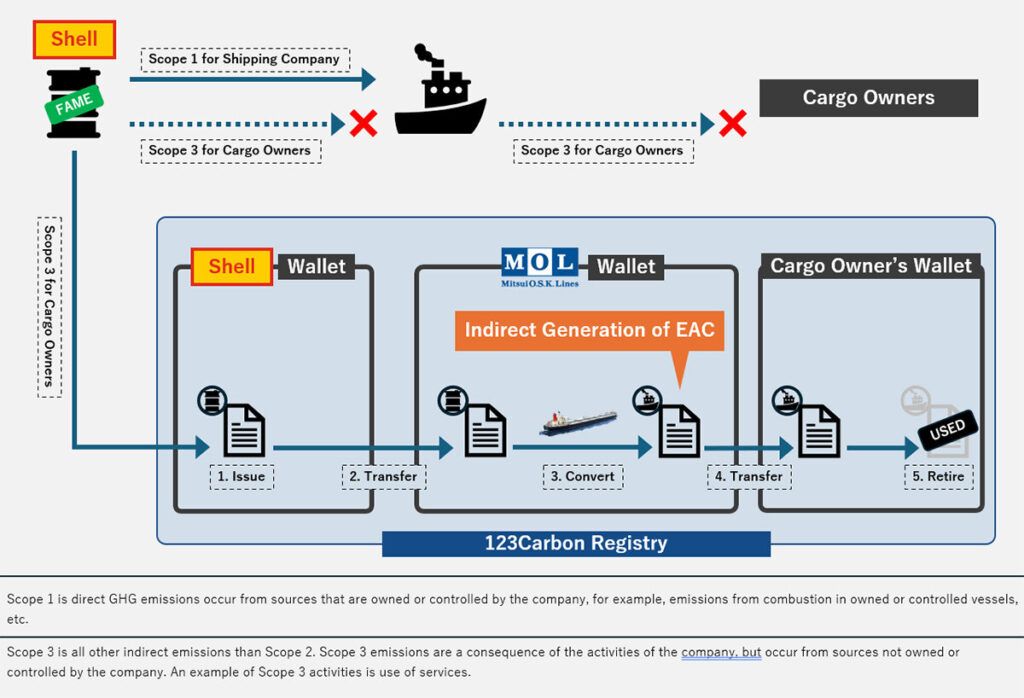
This process provides an option for companies seeking to report Scope 3 emissions without securing access to vessels running on alternative fuels or relying on specific trade routes where such fuels are available. The certificates are linked to recorded fuel-switch events and verified through an established accounting framework.
The initiative relies on digital registries and standardised accounting rules to track and allocate emissions reductions. 123Carbon records the transaction data, while the Smart Freight Centre framework defines how emissions benefits are attributed across the value chain.
Both MOL and Shell are members of the Book and Claim Community and in a joint statement said that the initiative ‘reaffirmed that the lifecycle GHG emission reduction value for the cargo owners generated from a low-carbon fuel switch on a third-party vessel can be credibly allocated’ when aligned with established accounting frameworks.